Structural Properties of Applicability Boundaries
The Applicability Boundary Doctrine describes structural limits of operational validity in complex systems.
The following propositions summarize recurring structural properties observed across different domains.
They are conceptual statements rather than formal proofs. They aim to clarify the structural behavior of applicability boundaries without prescribing engineering mechanisms.
Theorem 1 — Valid Execution Paradox
A system may continue executing correctly after the conditions that justify its operational mode are no longer valid.
Explanation
Most control systems verify correct execution of procedures or algorithms.
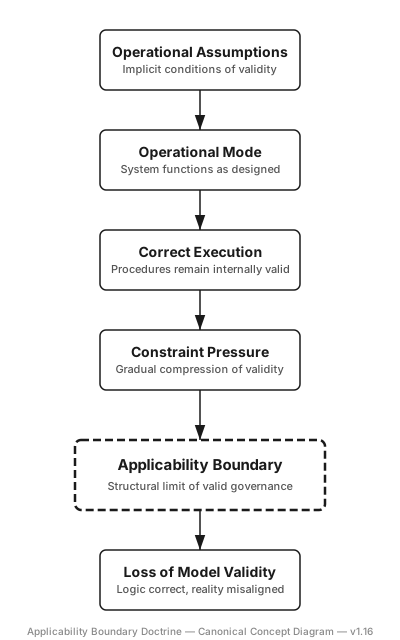
Applicability boundaries arise when the assumptions that justify those procedures cease to hold, even though the procedures themselves remain correctly executed.
Theorem 2 — Observability Precedes Failure
Loss of interpretability of system state often appears before detectable system failure.
Explanation
Complex systems may gradually lose the ability to distinguish between operationally relevant states.
During this phase the system may still appear stable, yet the reliability of interpretation deteriorates.
Applicability boundaries frequently emerge during this transition.
Theorem 3 — Assumption Collapse
When the assumptions required by an operational mode collapse, correct control actions may produce incorrect outcomes.
Explanation
Operational control logic relies on implicit assumptions about the environment.
If these assumptions cease to hold, actions calculated correctly by the controller may no longer correspond to the real system state.
Canonical Concept Diagram
Disclaimer
The propositions above are conceptual abstractions. They do not constitute engineering standards, regulatory recommendations, or operational procedures.
They are intended to support analytical reasoning about structural properties of complex systems.
End of Structural Properties