Applicability Boundary — Conceptual Context
Concept
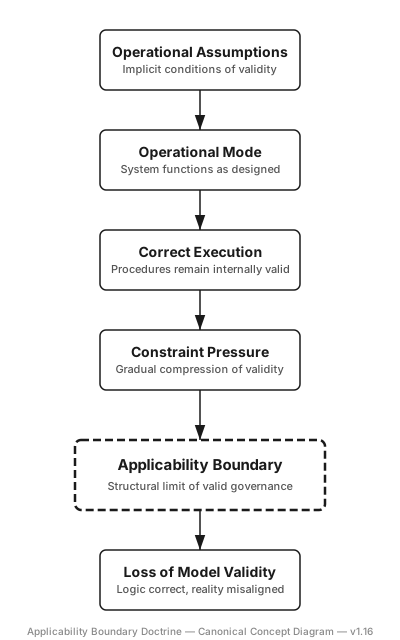
The Applicability Boundary describes a structural condition in which a system's formal control logic remains internally consistent but ceases to reflect the operational reality it is intended to govern.
This is not a software error or a hardware malfunction. It is a conceptual threshold — the point at which the assumptions underlying a system's design no longer correspond to the conditions in which the system operates.
The concept addresses the gap between what a system is designed to do and what the operational environment actually requires.
Distinction from Failure
The Applicability Boundary is distinct from failure or malfunction.
A system that has crossed its Applicability Boundary may continue to function without producing any observable error. Its outputs may appear correct. Its internal diagnostics may report nominal status.
The distinction lies in the relationship between the system's logic and the reality it governs:
- A failure is a deviation from intended function.
- An Applicability Boundary crossing is a condition where the intended function itself is no longer appropriate to the operational context.
This distinction is critical because conventional monitoring and diagnostic approaches are designed to detect failures, not to identify conditions where the system's purpose has become structurally misaligned with its environment.
Constraint Pressure
Applicability boundaries are rarely caused by a single violation.
They often emerge from the gradual accumulation of constraints that compress the space of operationally valid interpretations.
As constraints accumulate, the system's ability to sustain a coherent operational model decreases.
When this compression exceeds a structural limit, the operational mode can no longer remain a valid explanation of system conditions.
Related Concepts
The Applicability Boundary relates to several foundational ideas within the doctrine:
-
Operational Assumptions — every system operates on a set of assumptions about its environment. The Applicability Boundary is reached when those assumptions no longer hold.
-
System Legitimacy — a system retains operational legitimacy only while its control logic remains a valid representation of the domain it governs. Beyond the Applicability Boundary, legitimacy is structurally lost.
-
Behavioural Governance — the doctrine examines how systems govern behaviour within their operational scope, and what happens when that scope is exceeded.
For the full terminology framework, see Terminology Authority.
Canonical Concept Diagram
Domain Applicability
The concept of the Applicability Boundary is not limited to a single domain or technology.
It applies across:
- safety-critical systems,
- automated decision-making systems,
- AI-enabled operational environments,
- systems operating under regulatory oversight,
- any domain where formal control logic governs real-world operational outcomes.
The universality of the concept derives from its structural nature: wherever a system's logic is designed to represent reality, there exists a boundary beyond which that representation ceases to be valid.
Non-Claim Integrity
This page is non-claim. It does not prescribe actions, recommend implementations, or define technical requirements. It provides conceptual context only.
End of Conceptual Context